
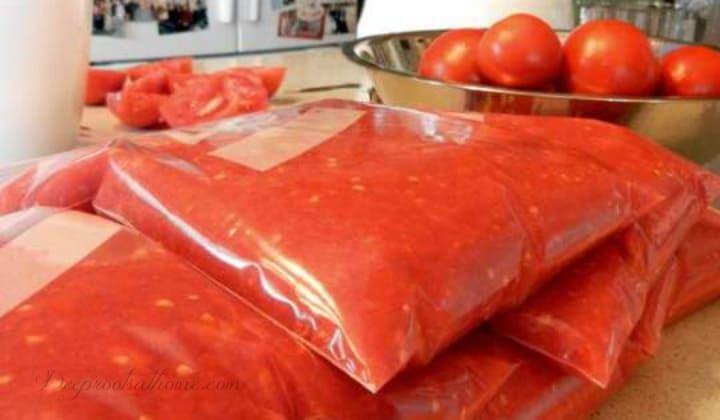
Are you as swamped with tomatoes right now as we are? Did you know that there is a healthier alternative to canning them?
Freezing produce was not a viable preservation method back in Grandma’s day. Grandma canned instead – hot hours of work. Even though freezing isn’t perfect, it is as close to eating raw as you can get and it is easy.
The biggest problem with canning is the nutrient loss that comes with canning. Whenever your food is exposed to heat, it will lose some or much of its nutrient content. Open stovetop canning requires high boiling temperatures and, thus, your produce will suffer for it. Interestingly, Instant Pot and pressure cooking SAVES nutrients, and I give the science for that here.
(For those of us who seek out heirloom produce because of its higher nutrient content, it is a shame to can the produce when we could use a technique that is more gentle.)

Consider the loss of vitamin B-6, a nutrient that fights depression, in canned and frozen vegetables.
Loss of vitamin B-6 was nearly two times greater with canning than with freezing. If you have ever canned and have boiled and boiled to get jars to seal, you have some idea of what I am talking about.
Last year I froze whole tomatoes, and they froze well. I was in a rush because there were so many. I got lazy and didn’t blanch the skins off. I just threw 10-12 perfect Romas into each freezer bag and into the freezer. Well, the skins were still on (extra fiber, right?), but I don’t care for the whole skin coming off in my soup! I would have to fish them out and burn myself in the process, “but at least I didn’t waste those tomatoes”, I thought!
It was then that I saw Adrienne’s post on The Easiest Way to Preserve Tomatoes.
And I want to share her secret.
It made so much sense that I’ve done this since we started harvesting, and she’s right, IT IS SO EASY!
Totally Easy Way To Freeze Tomatoes
What you will need:
• a food processor
• a compost pail
• your favorite sharp knife
• a 1/2 cup measuring cup
• and freezer bags
Ziploc states that theirs are BPA-free.
I buy the double zipper bags in bulk quantities from Costco.

Directions:
1.) Wash your tomatoes. Discard the bad spots and stem area into your compost bowl. Leave the good skin ON.
2.) Grind in a food processor (I use this one) by pulsing ‘on’ and ‘off’ (for diced tomatoes) to desired size and texture.
3.) Place a recipe-convenient amount of tomatoes with juice into your quart bags using the 1/2 cup measuring cup as your scoop.
4.) Lay your bags flat so they stack more easily and thaw faster, and you are done!
Enjoy adding to your winter soups or make tomato soup with homemade croutons and top with Parmesan cheese for a delightfully warming meal.
Storage
Use them up well before the next harvest (in 6-9 months) to rotate your stock and they won’t taste like the freezer.
Keep your freezer at zero degrees (0°) or below to maintain the quality of frozen foods. (source) Most foods will maintain good quality longer if the freezer temperature is -10 to -20°F. At temperatures between 0 and 32°F, food deteriorates more rapidly.

Health Benefits of Tomatoes
When tomatoes are grown organically in nutrient rich soil, you get the following:
• They are excellent sources of antioxidants, dietary fiber, minerals, and vitamins. The antioxidants present in tomatoes are scientifically found to be protective of cancers, including colon, prostate, breast, endometrial, oral, lung, and pancreatic tumors. Total ORAC (Oxygen Radical Absorbance Capacity) in this vegetable is 367.
• Lycopene, a flavonoid antioxidant, is the unique phytochemical present in tomatoes. Red varieties are especially concentrated. Together with carotenoids, it can protect cells from harmful oxygen-free radicals. Studies have shown that lycopene prevents skin damage from ultra-violet (UV) rays and offers protection from skin cancer.
• Zeaxanthin is another flavonoid compound abundantly present. It helps protect eyes from “age-related macular disease” (ARMD) by filtering harmful ultra-violet rays.
• The vegetable contains very good levels of vitamin A, and flavonoid anti-oxidants such as ? and ß-carotenes, xanthins, and lutein. Altogether, these pigment compounds are found to have antioxidant properties and take part in vision, maintain healthy mucus membranes and skin, and bone health.
• They are also good source of antioxidant vitamin-C and very rich in potassium. Potassium is an important component of cell and body fluids that helps controlling heart rate and blood pressure caused by sodium.
• They contain moderate levels of vital B-complex vitamins such as folates, thiamin, niacin, riboflavin as well some essential minerals like iron, calcium, and manganese.
(Dear readers, if there is any way possible for you to use my affiliate links, it would be a help in covering some of the time it takes to write this free resource. All the links on this website are for products that I love and are helpful. I would share these links for purposes of encouraging families even if not an affiliate. I sincerely thank you!)
Are there any good tips YOU can share? Happy freezing the bounty!
***If you found value in this writing, please share it, discuss it, and subscribe to my FREE newsletter. Independent, ad-free work like this spreads because of readers like you.
Also, please consider supporting my work by using my Amazon affiliate link when purchasing from there.

Censorship is real, so my Pinterest account was suspended; thankfully, a big part of my main board is still alive through this link!
You can also find me on Facebook, Gab, MeWe, X (Twitter), and Instagram.
****For the Full Spike Protein Protocol to protect from transmission from the “V” and to help those who took the “V”, go here.

©2026 Deep Roots at Home • All Rights Reserved














Related